

In GMP manufacturing, humidity is a critical environmental parameter wherever is can affect the product, the process, or the performance. Humidity control is not just a facilities issue; it is part of maintaining a validated manufacturing environment.
For this reason, humidity should be monitored with instrumentation that gives reliable, repeatable data and can be integrated into the site’s wider environmental control strategy. The Novasina nLink+ is designed for exactly this type of application, providing relative humidity (RH) and temperature monitoring for controlled and industrial environments.
Novasina nLink+ DI Humidity & Temperature Transmitter
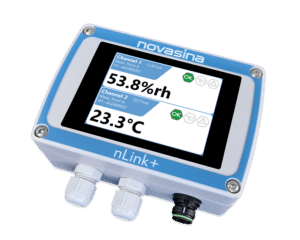
- Dual channel transmitter with 2 analog signal outputs
- IP54 case
- Integrated 2.8 zoll LCD touch display
- Configuration with USB cable for Windows PC
- Compatible with all exterior nSens sensor (such as nSens-HT-EIS, Sens-dP etc) and extension cables
- 2 scalable analogue outputs: current 0/4 to 20mA or voltage 0/2 to 10V
Novasina nLink+ IP Humidity & Temperature Transmitter
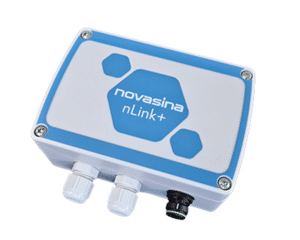
- Dual channel transmitter with 2 analog signal output
- IP65 case
- Configuration with USB cable for Windows PC
- Configuration possible without external power supply
- Compatible with all exterior nSens sensor (such as nSens-HT-EIS, Sens-dP etc) and extension cables.
Not universally. GMP guidance does not prescribe one standard humidity range for every facility or process. The acceptable RH limit should be defined according to the product, process, room use and risk assessment. In other words, the correct humidity range depends on what is being manufactured and what environmental conditions are necessary to maintain quality.
That makes accurate monitoring especially important. Once site-specific limits are set, the monitoring system has to show whether the environment remains within those limits and how quickly excursions are identified. The nLink+ supports this by providing continuous RH and temperature measurement with analogue outputs for system integration.
Effective humidity control can support several important areas in GMP manufacturing:
Product Stability
Some products, raw materials and packaging components are sensitive to moisture exposure or changing environmental conditions. Keeping humidity within defined limits can help protect product integrity and reduce avoidable variability.
Process Consistency
Stable environmental conditions help support repeatable manufacturing. Where a process is sensitive to atmospheric change, controlling humidity can help reduce drift between batches, rooms or production stages.
GMP Compliance
GMP is built around controlled processes, documented conditions and evidence that systems remain within defined limits. Humidity monitoring supports that wider need for control, traceability and action when excursions occur.
A strong humidity control approach in GMP environments usually includes:
- defined environmental limits for relevant rooms or processes
- reliable, ongoing monitoring of humidity and temperature
- recorded data to support traceability
- alerts for out-of-limit conditions
- calibrated monitoring equipment and routine verification of performance
Spot checks can be useful, but they may miss changes that happen between readings. Continuous monitoring gives better visibility of trends, deviations and environmental stability over time. That is especially valuable in regulated environments where evidence of control matters, not just a single reading taken at one moment.
The impact depends on the application, but common risks can include changes in material behaviour, compromised product quality, inconsistent process conditions and weaker compliance evidence if deviations are not detected or recorded properly. In sensitive areas, poor environmental control can also increase contamination-related concerns.